
Fee reconciliation
How M-Pesa School Fee Reconciliation Works in Kenya
A practical look at the difference between receiving an M-Pesa school-fee payment and reconciling it to the correct learner invoice, allocation, balance, credit, and receipt.
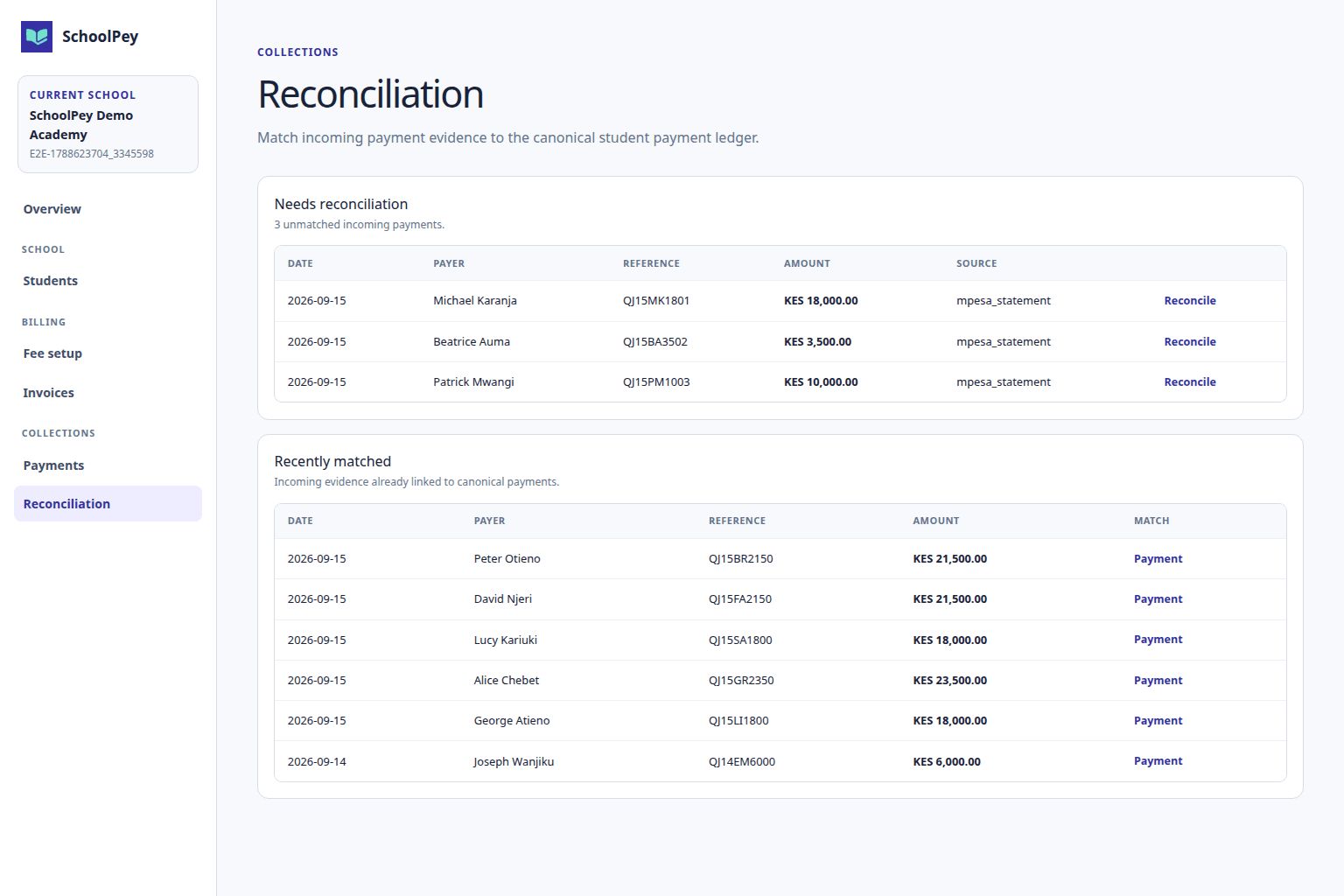
When a parent pays school fees through M-Pesa, the school has two separate questions to answer: did money arrive, and what exactly did that money settle? The first question is about payment evidence. The second is reconciliation.
A useful reconciliation workflow should preserve the learner, invoice, amount received, provider reference, amount allocated, any amount carried forward as learner credit, and the receipt or statement trail left behind after the transaction.
Start from the learner invoice
SchoolPey treats the learner invoice as the financial obligation being settled. The invoice preserves what was billed and when it was issued. A parent payment should not rewrite that historical invoice; it should create settlement activity against it.
For eligible M-Pesa payments, the parent starts from the relevant learner invoice in the SchoolPey parent experience. That gives the payment flow a known school, learner, invoice, and expected amount context before provider confirmation arrives.
- The parent sees only learner records authorized through the guardian relationship.
- The parent approves payment through the normal M-Pesa flow.
- SchoolPey does not receive or store the parent's M-Pesa PIN.
Wait for provider confirmation
A client-side success message is not enough to establish financial truth. SchoolPey observes the provider-side result and keeps incoming payment evidence separate until it is safe to create or reconcile the canonical payment record.
This distinction matters because a school needs a durable transaction reference and a defensible record of what happened, especially when a parent later asks whether a payment was received or why a balance changed.
Create one canonical payment and allocate it explicitly
Once the incoming payment is confirmed, SchoolPey converges the transaction into the same canonical payment ledger used by the rest of the product. The amount received and the amount applied to invoices remain explicit rather than being hidden inside a mutable balance field.
The core relationship is simple: money received is either allocated to invoices or carried forward as learner credit. That makes partial payments and overpayments understandable without inventing a second accounting path for M-Pesa.
- A partial payment leaves the remaining invoice amount outstanding.
- A full settlement brings the invoice balance to zero through allocation.
- An eligible overpayment can carry excess money into the learner credit ledger instead of producing a negative invoice balance.
Keep the learner record, receipt, statement, and reports aligned
After reconciliation, the school finance team should not have to update a spreadsheet, receipt book, statement, and dashboard independently. The same canonical invoice, payment, allocation, and credit history should drive each surface.
In SchoolPey, that means the learner finance record, payment history, receipts, student fee statement, balances view, payment ledger, and school fee reports can all explain the same transaction from their own perspective.
What the school finance team should be able to investigate
Good reconciliation is not only about automation. Staff still need enough context to investigate exceptions. A bursar or accountant should be able to move from incoming payment evidence or a provider reference to the learner, invoice, allocation, and proof behind it.
- Who paid and which learner account received the payment.
- Which invoice or invoices received allocation.
- How much was received, allocated, or carried forward as credit.
- The provider or external transaction reference.
- The resulting invoice balance and receipt history.
For the product workflow, see M-Pesa school fee collection, school fee reconciliation, and school fee balances.
Why this is narrower than a full school management system
SchoolPey focuses on the financial side of school fees. Academic years, terms, grades, and classes are used where they identify billing context, but the product does not expand into exams, marks, attendance, timetables, curriculum, or other academic-management modules.
For a school evaluating fee software, that boundary is useful: the goal is to make billing, collection, reconciliation, balances, receipts, statements, and reporting reliable without requiring the school to replace every academic system it already uses.
Continue with the product workflow
Keep invoices, M-Pesa payments, balances, and receipts connected.
SchoolPey gives the school finance team and authorized parents one canonical fee history instead of separate payment messages and spreadsheet updates.
Request a 1-month pilot