
Outstanding balance
See the amount still receivable after canonical settlement activity.
School fee tracking system
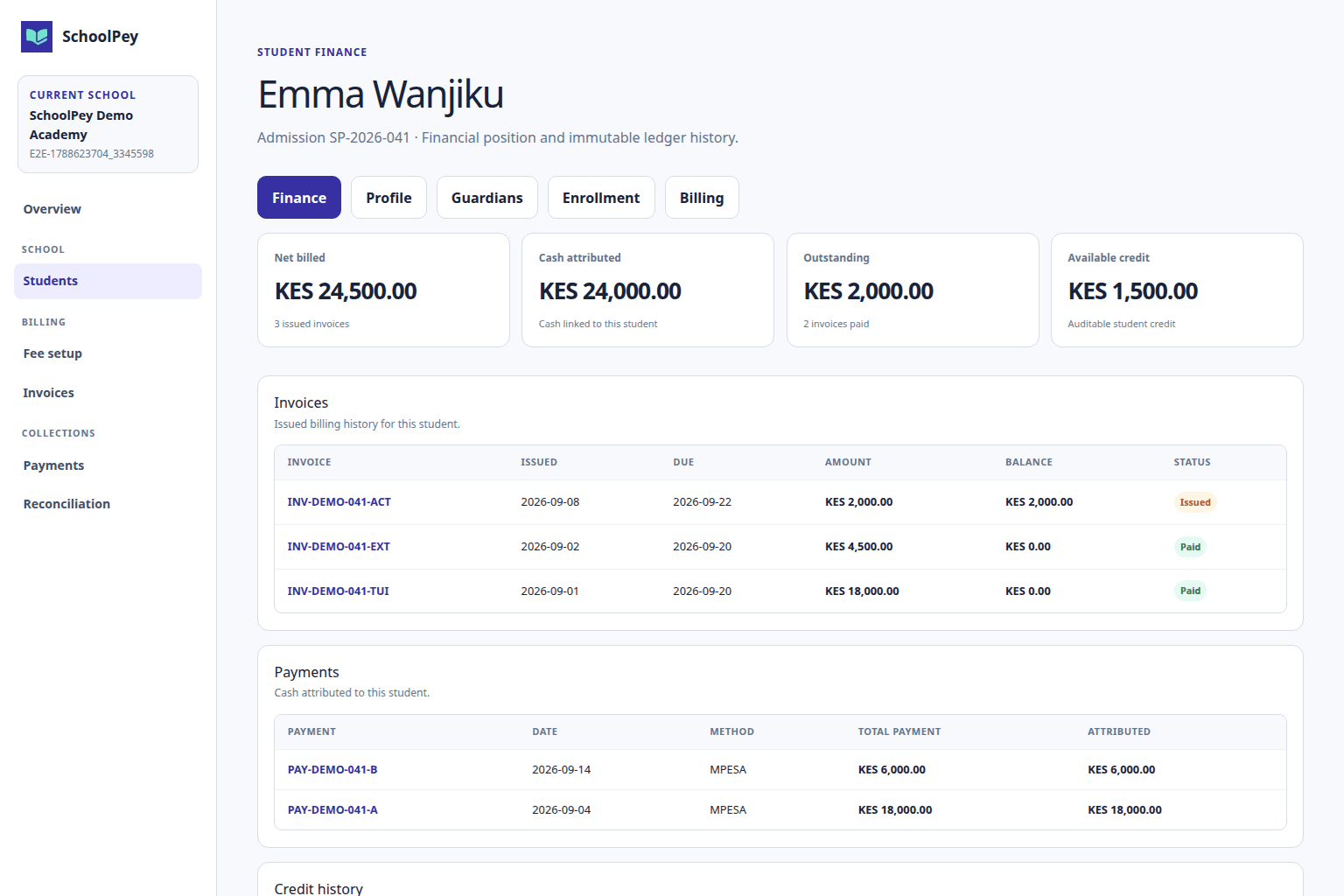
SchoolPey keeps net billed fees, settlement, outstanding receivables, overdue balances, and available learner credit distinct so the finance team can follow up from a defensible record.
The operational problem
SchoolPey reconstructs the learner financial position from issued invoices, canonical payments, allocations, and the learner credit ledger instead of treating one mutable total as the financial truth.
See the amount still receivable after canonical settlement activity.
Identify fee obligations that remain unpaid past the relevant due date.
Keep the invoice open for the remaining amount rather than incorrectly marking it paid.
Allocate what the invoice needs and carry eligible excess forward as learner credit.
Do not hide available credit by showing it as a negative invoice balance.
Open the learner finance history behind the current position.
How SchoolPey handles the workflow
The invoice establishes what was billed and when it became due.
Payments and credit applications settle the invoice through explicit allocations.
Use outstanding, overdue, and available-credit views without collapsing them into one ambiguous number.
Frequently asked questions
The payment is allocated to the invoice and the remaining amount stays outstanding until further settlement occurs.
SchoolPey can allocate the amount needed by the invoice and carry the excess into the learner credit ledger for later use.
No. Credit and receivables remain separate until credit is explicitly applied through the canonical credit ledger.
Try the real workflow
Evaluate the fee operation with actual billing, payment, reconciliation, balance, receipt, statement, and reporting workflows before standard billing.
Request a 1-month pilot